

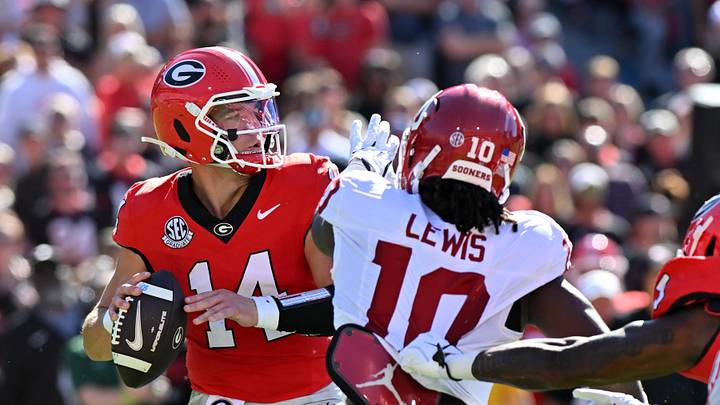
Georgia fans will look at their phones, see the 41-13 final score, and think, "Mike Bobo and the Georgia offense rolled again". Yes, Georgia rolled, but the offense sputtered more often than not. It's important to know that both can be true.
On the surface, criticizing anything about the offense sounds ridiculous when Georgia just scored over 40 points for the fourth consecutive week.
But the scoreboard can be deceptive: Georgia finished with just 307 yards, helped by four Oklahoma turnovers and one touchdown that came directly from the defense.
Georgia dominated Oklahoma. That doesn't mean Georgia's offense dominated Oklahoma. The final box score gives you 41 points. The underlying performance gives you:
- 307 total yards (177 passing, 129 rushing)
- 5.8 yards per play.
- 14-of-25 passing for Gunner Stockton
- One defensive touchdown
- Four turnovers forced
The 5.8 yards per play needs context because Dwight Phillips' 54-yard touchdown and Talyn Taylor's explosive receptions inflate the average. That's not to say explosive plays don't count -- obviously they do -- but Georgia generated enough explosives to overcome an offense that wasn't consistently staying ahead of the chains.
More importantly, according to PFF, Georgia's offense posted just a 34% success rate. A couple of explosive plays and advantageous situations via OU turnovers helped produce points, but roughly two-thirds of Georgia's offensive plays were unsuccessful.
When you look at teams like Alabama, Florida and Ole Miss looming on the schedule, that could be a concerning stat.
Oklahoma's defense deserves plenty of credit for Georgia's struggles
Oklahoma came to Athens with one of the better defensive units Georgia will see this season, and that's important context to have when looking at an offensive performance that could be considered less than.
The Sooners aren't suddenly a bad defense because Georgia put 41 on the scoreboard. Some of Georgia's offensive struggles happened because Oklahoma was typically aggressive and strong defensively. But some happened because Georgia made life unnecessarily difficult for itself.
Until Phillips' huge touchdown run in the 4th quarter, Oklahoma held Georgia to under 60 total rushing yards. That was no accident. The Sooners have an outstanding defensive line, and that defense is what's kept them in every game until today.
But even great defenses can be defeated by mental errors and mistakes committed by their own offense, and John Mateer and the Sooners' offense gave Georgia a lot of help in that aspect. Despite all that, it almost seemed like Georgia tried to cordially keep Oklahoma in the game.
Mike Bobo got away from what Oklahoma hadn't proven it could stop
The first half showed that Georgia could create opportunities against that attacking defense. Taylor was producing explosive plays. The Bulldogs had success with running concepts, using 12 and 13 personnel, hitting the edges and stretching the defense.
Using these schemes, they'd built a 28-0 lead, and Oklahoma looked all but defeated heading into the tunnel at halftime.
Then something changed in the third quarter.
Bobo stopped doing what had worked, and seemed to want to fix what -- to that point -- wasn't broken. The Bulldogs opened the 3rd quarter with a run up the middle for a 1-yard gain, and then a pass to the outside that was intercepted.
Then the next possession:
Short incompletion
2-yard run up the middle
Deep incompletion
Short incompletion
Punt
The next possession:
Short completion
Deep incompletion
Deep incompletion
Field Goal
The next two Georgia possessions were very similar, and there was no logical explanation for why Bobo had gotten away from the schemes that were working without Oklahoma showing they could stop them. Fans watching the game on social media noticed, and so did ESPN announcer Louis Riddick, who was the color analyst in the booth.
Riddick noticed the shift during the broadcast, pointing out that Georgia appeared to be getting away from the offensive identity that had worked. More than once, he questioned the offensive strategy and mused that Georgia needed to get back to playing "Georgia football".
And that's the frustrating part.
Oklahoma adjusting and stopping something is one thing. Georgia abandoning something before Oklahoma proves it can stop it is another.
Georgia found enough answers against Oklahoma but needs more consistency
Georgia can celebrate the result without ignoring how it got there. The win over Oklahoma wasn't an abject failure by Georgia's offense. The ceiling still looks considerably higher than the performance it actually delivered on Saturday.
Oklahoma deserves credit for playing a strong defensive game; Georgia deserves credit for beating a good Oklahoma team; Bobo deserves criticism for some of the third-quarter decisions, and Stockton and the offense have areas that need improvement.
Georgia won't apologize for scoring 41 points against one of the country's better defenses, nor should it. But a 34% offensive success rate tells a much different story than the scoreboard. A third quarter riddled with an odd offensive scheme change needs to be explained.
The Bulldogs were good enough to beat Oklahoma comfortably without their offense ever becoming consistently frightening. Eventually, they're going to face an opponent where comfortable won't be enough.
 Add us as a preferred source on Google