

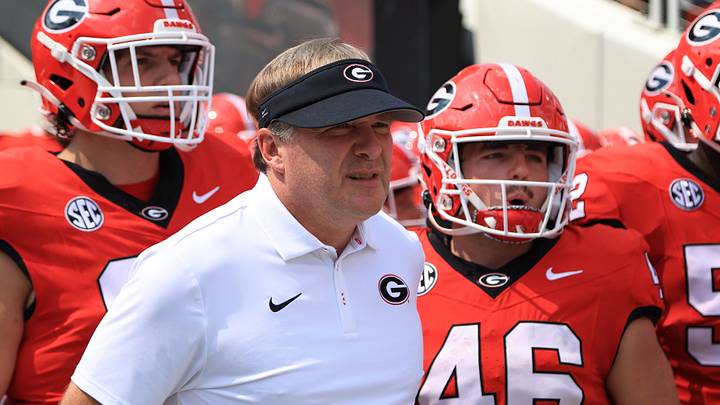
Georgia fans, the sky isn't falling. Despite the narrative that Georgia is falling behind in the NIL spending frenzy era, Kirby Smart has things well in hand. His philosophy goes far beyond just buying the "best" players.
In a recent article in The Athletic, the spending habits of major college football programs were revealed and ranked, with Georgia falling 19th on the list. The immediate reaction would naturally be that Georgia and Kirby Smart aren't spending enough to keep up.
I would argue that the opposite is true. Other teams are spending too much and getting less return on their investments than Georgia. At the time of the article's publication, No. 2 Georgia is ranked higher than 17 of the 18 teams that are spending more money, with No. 1 Texas as the outlier.
Speaking of that team from Austin, Georgia's NIL spending makes Kirby Smart's recent success against Texas look even better. Steve Sarkisian is spending roughly $10-15 million more than Georgia this year, and while The Athletic didn't release numbers for previous seasons, he's 0-3 against the Bulldogs during the NIL era.
Kirby Smart is saving Georgia millions and still getting results
In an era when other programs are solving roster problems by spending more money, Georgia doesn't need to win every bidding war to assemble a championship-caliber roster. Kirby Smart has created a program where the Georgia brand has monetary value.
A player choosing between comparable offers from other schools can factor in Georgia's NFL development, playing for Smart, competing for SEC and national championships, and individual honors. That doesn't mean Georgia isn't spending a ton of money. It means Georgia apparently doesn't have to be No. 1 in spending to recruit and retain a No. 1-caliber roster
Could Georgia have outbid Michigan and other schools for quarterback Bryce Underwood? Probably, but look at how much Michigan paid versus what they've gotten back on their investment. Kirby Smart has said on multiple occasions that he wants players who want to play for Georgia and want to win championships, not players who want to add some extra zeros and commas to their bank balance.
Georgia's success is not waning in the least
The results are clear -- you can win and sustain success without spending like a failing franchise chasing a quick fix.
There are some who might argue that Georgia's success has fallen off in recent years as NIL spending has taken over the sport. Since the 2022 National Championship, Georgia has missed the playoff one year and has been bounced out of its first playoff game in each of the last two seasons. That seems to be the argument that Georgia has fallen off.
That's a facile argument using some pretty low-hanging fruit.
Georgia was quite unfairly left out of the 2023 four-team playoff. No one from the playoff committee can quite explain how a team drops from No. 1 to No. 6 simply by losing a conference championship game to a ranked Alabama team.
In the 2024 playoff, after losing its starting quarterback in the SEC Championship Game, Georgia was forced to throw Gunner Stockton into the fire against a very good Notre Dame team in his first career start.
Georgia's 2025 playoff game was a hotly contested rematch with Ole Miss, in a game that either team could truly have won. Could Georgia have advanced beyond that had they beaten the Rebels? There's no way of knowing, but given the matchups, it seems likely.
So measuring Georgia's success against what they spend on NIL doesn't hold up to scrutiny. Success is winning more games than any other program in the country over a five-year span. Success is winning your conference championship three of the last five years. Success is regularly beating teams who are spending more money than you are.
More than Georgia falling off, it's more the rest of the pack catching up and closing the gap that once existed between the Georgia-Alabama coalition and the rest of the field. NIL has brought a certain amount of parity but hasn't damaged Georgia's program.
In other words, if you're trying to equate Georgia's spending to performance on the field, your math ain't mathing.
Note: The dollar figures stated by The Athletic are estimates, not audited payroll figures. NIL numbers remain unusually difficult to verify because many arrangements aren't publicly disclosed, and even published budget comparisons don't necessarily measure the same things.
 Add us as a preferred source on Google