

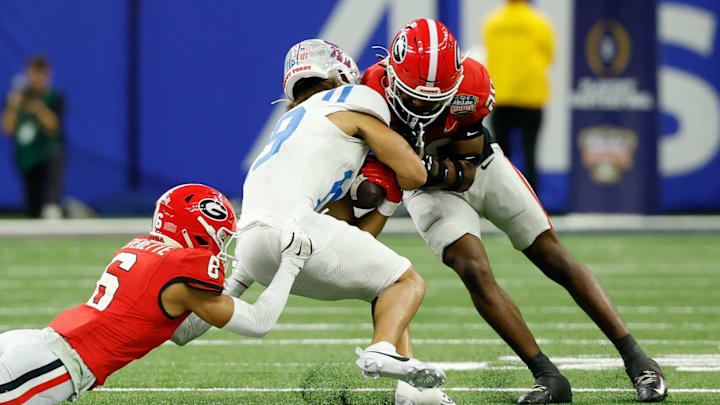
The adoption, implementation, and enforcement of the controversial targeting penalty has done more harm than good in college football. It was supposed to be about protecting the players from themselves. In reality, it has been more about the officials having way too much of an impact on any given game. Every college program has dealt with several questionable targeting calls over the years.
According to Chris Vannini of The Athletic, the NCAA rules committee could be making a change to it.
Per sources, the NCAA rules committee will consider getting rid of the targeting carryover suspension this week.
— Chris Vannini (@ChrisVannini) February 22, 2026
They also want to start penalizing the short-shorts (which are already against the rules).
Free story: https://t.co/9Zk47e303Z pic.twitter.com/rvtFKE1akm
Per Vannini's intel, "The NCAA rules committee will consider getting rid of the targeting carryover suspension this week." While this overly punitive rule would not have impacted what was JaCorey Thomas' final game of his college football career at Georgia vs. Ole Miss in the Sugar Bowl, any amendments to the targeting penalty is a big win for college football players, the fans, and the sport.
Let's now unpack the significance of what eliminating the carryover suspension may do for targeting.
NCAA rules committee amending targeting penalty helps Georgia a ton
With the way the targeting penalty has been enforced, if a player has does commit targeting, he is out for the rest of the game. If this penalty occured in the first half, he can return to start the following game in the first half. If a player committed targeting in the second half of a contest, he would then have to sit out the first half of the following game. The latter proved to be far too punitive in the end.
So again, this may not have impacted Thomas' time at Georgia, as his questionable targeting penalty was committed on Ole Miss wide receiver Cayden Lee near halftime. However, any leniency on this egregious penalty is a boon to the players and the coaching staffs to counterbalance. This would be a big step in potentially removing the penalty all together. There has to be a better way to do this...
What transpired in the second half for Georgia following Thomas' exit was substantial. An already depleted Georgia secondary got even more exposed vs. Trinidad Chambliss and the Ole Miss offense firing on all cylinders. Because the penalty has been so punitive, it has changed the way that players approach tackling. Regardless of if a penalty is deemed worthwhile, there are ripple effects to be had.
In the end, targeting penalties often play far more of a role in what team wins and loses in a tight contest. Unnecessary roughness could be a way to get the point of this kind of penalty across without changing the entire paradigm of a game on the fly. Georgia had a chance to win this year's national championship. However, it was a youthful team that was exposed by a bad targeting penalty.
While this change would not have impacted Thomas, it would have redefined his final snap at Georgia.
 Add us as a preferred source on Google