

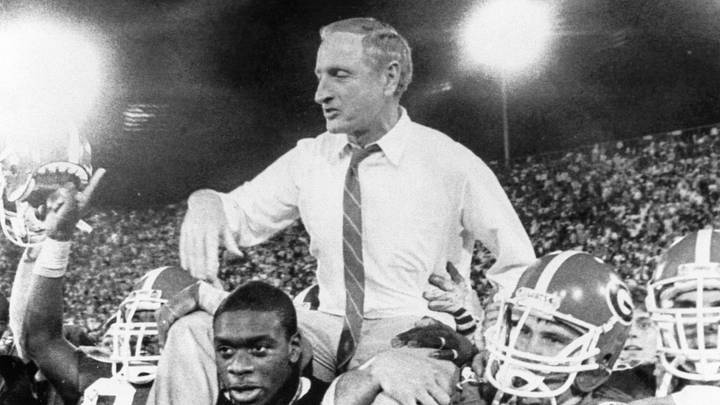
There are reasonable arguments to be made about the greatest coaches in college football history. Who belongs in the top five? How much should national championships matter? Is sustained excellence more impressive than a brief period of dominance?
But some coaching resumés should be strong enough to make their inclusion among the sport's all-time greats an emphatic spike in the end zone. Georgia's Vince Dooley's is one of them.
That's what makes Sports Illustrated's recent ranking of the 25 greatest college football coaches of all time so difficult to understand. The piece assembled an impressive collection of coaching legends, from Nick Saban and Bear Bryant to Bobby Bowden and Tom Osborne. Somehow, the former Georgia Bulldogs coach didn't make the cut.
No one is saying that every Georgia legend should receive special treatment. But recognizing a coach who spent a quarter-century building and sustaining one of the most successful programs in the Southeastern Conference and in the country shouldn't be a question.
What should be questioned is whether college football has become so mesmerized by extraordinary accomplishments happening now that it sometimes loses perspective on the greatness of the past.
Vince Dooley's 25 years at Georgia speak for themselves
Consider what Dooley accomplished during his 25 seasons leading Georgia from 1964 through 1988.
He won 201 games, six SEC championships and the 1980 national championship. His teams appeared in 20 bowl games, and he finished his coaching career with a 201-77-10 record.
Those aren't the accomplishments of a coach who enjoyed one special season or happened to briefly catch lightning in a bottle; they're the foundation of an incredible career.
Dooley guided Georgia through different generations of players, changing competition, and the challenges that come with maintaining a successful college football program over multiple decades.
His Bulldogs won SEC championships in 1966, 1968, and 1976 before capturing three consecutive conference titles from 1980 through 1982. That final stretch included Georgia's undefeated 1980 national championship season, one of the defining achievements in the school's football history, as well as two more shots at the national title in 1981 and 1982.
Dooley also coached Herschel Walker, who won the Heisman Trophy in 1982, earned seven SEC Coach of the Year awards during his career, and was inducted into the College Football Hall of Fame in 1994.
It's difficult to imagine what more Dooley could have done to establish his credentials as one of the sport's great coaches, short of winning additional national championships. And while championship totals certainly matter, they shouldn't be the only measure of greatness. Otherwise, we're not really evaluating the greatest coaches in college football history. We're just counting trophies.
College football greatness should be measured over time
One of the more revealing parts of Sports Illustrated's ranking is the inclusion of Indiana coach Curt Cignetti at No. 25.
Let's be clear about something: What Cignetti accomplished at Indiana deserves enormous recognition. Taking a program with Indiana's historically dismal football past and leading it to the 2025 national championship is one of the most remarkable coaching achievements the sport has ever witnessed.
But there's a difference between recognizing one of the greatest coaching achievements in college football history and declaring someone one of the 25 greatest coaches in the history of the sport. There's a stark difference that has to be acknowledged when you start using the phrase "all-time".
Cignetti may eventually retire with a resumé that leaves no doubt about his standing among the greatest of all time. Perhaps that incredible turnaround at Indiana will prove to be the beginning of a prolonged era of championship contention, but that portion of his career hasn't been written yet.
Vince Dooley's has.
We know what Dooley accomplished after his first conference championship. We know what happened after his second. We know that his national championship wasn't the end of his success, because Georgia followed it with two more SEC titles and continued sustained winning.
We know that he continued coaching the Bulldogs through 1988, completing a 25-year tenure that helped define Georgia football for generations, and that kind of longevity should count for something. In fact, it should count for quite a lot when the subject is the greatest coaches of all time.
This isn't an argument that active coaches should be excluded from historical rankings. Kirby Smart, for example, has already built a substantial legacy at Georgia, and his place in the sport's history doesn't depend on when he decides to retire. However, that doesn't mean he should be included as one of the all-time greatest either.
Few coaches could be considered among the all-time greats while they were still coaching -- one Nick Saban leaps to mind -- but he had already cemented his place among the sports greatest years before he stepped away.
The argument is that greatness should be judged by the entirety of a coach's accomplishments rather than the excitement surrounding the most recent ones, with rare exceptions of sustained greatness at the sport's highest level while still prowling the sideline.
Leaving Vince Dooley out overlooks what made Georgia great
Georgia fans have spent much of the past decade rightfully celebrating the unprecedented success that Kirby Smart has brought to Athens. Smart has elevated the Bulldogs into a modern college football powerhouse, winning consecutive national championships and establishing a standard of excellence few programs can match.
But recognizing what Smart has accomplished shouldn't diminish the foundation Dooley helped establish.
Before Smart became synonymous with championship football in Athens, Dooley had already delivered the school's first consensus national championship since 1942 and built a program capable of competing for SEC titles across multiple decades. He established a winning tradition that became an essential part of Georgia's identity.
That doesn't mean Dooley belongs ahead of every coach on Sports Illustrated's list. There are legitimate arguments to be made about how the sport's greatest figures should be ranked. But a ranking that honors 25 coaches and excludes someone with Dooley's record deserves a second look.
Especially when the list makes room for a coach whose most significant accomplishment at the highest level of college football came only recently. Cignetti's success at Indiana is historic. Nothing about making a case for Dooley is meant to diminish that achievement. But should we allow the excitement of a new chapter to overshadow an entire completed career of excellence?
Sports Illustrated is entitled to its ranking, and debating lists like these is part of what makes college football so fascinating, but Vince Dooley's place among the greatest coaches in the history of the sport shouldn't require defending every time a new list is published.
His impressive record already made the argument, and it's an argument that should have been settled long ago.
 Add us as a preferred source on Google