

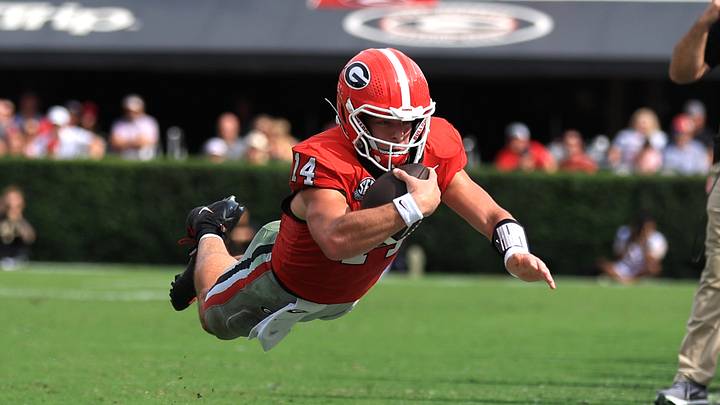
We may still not be entirely sure what Georgia is going to become this season. Saturday's 38-14 Homecoming win over Vanderbilt didn't provide much clarity, either.
If anything, this game gave us more reasons to believe this offense has a ceiling we haven't seen yet, and a couple more reasons to wonder what happens when Georgia eventually runs into an opponent capable of exploiting its defensive weaknesses.
But we learned a few things, some of them encouraging, and some concerning. And one that Mike Bobo might want to write down somewhere.
Georgia's secondary suddenly looks much more vulnerable in man coverage
Maybe some of the shortcomings in Georgia's secondary against Vanderbilt can be attributed to the change at quarterback, though it's hard to believe Kirby Smart didn't have his team prepared to face either Jared Curtis or Blaze Berlowitz. The latter exposed some holes in Georgia's secondary.
While the Vanderbilt backup only threw for 190 yards, he completed passes for five explosive plays over 15 yards, including a 60-yard touchdown pass to wide receiver Junior Sherrill as time was running out in the first quarter.
When Georgia blitzed, which seems like the only way the Bulldogs have been able to generate any quarterback pressure this year, Berlowitz had an answer throughout most of the first half. Georgia's defensive backs struggled in man coverage, and there were several missed assignments in pre-snap sets.
The defensive backs were able to right the ship somewhat in the second half, but what a backup quarterback from Vanderbilt was able to accomplish is a red flag for some upcoming games. Georgia's secondary hasn't become a weakness, but man coverage might have become something opponents are going to make the Bulldogs prove they can play.
Apparently, Georgia's defense can struggle against a running quarterback who can actually run
A week after Georgia faced Oklahoma and John Mateer spent much of the afternoon demonstrating the difference between being labeled a mobile quarterback and actually being one, Vanderbilt provided a much different challenge.
Berlowitz used his legs effectively against Georgia's pursuing defense. He was able to scramble out of trouble and complete passes, and was only sacked once on what looked to be a miscommunication in the play call on the part of his receiver.
The concern isn't merely quarterback rushing for big yards. It's what a legitimately athletic QB does to Georgia's defensive structure. Pass rushers can't simply pin their ears back, contain becomes ultimately more important, and blitzing isn't always the answer (or possibly even seldom).
This concern stacks on top of the man coverage worry, because if Georgia is struggling in man coverage and the quarterback can escape the pocket, you've suddenly created a nasty problem: defenders chasing receivers with their backs turned while the QB takes off.
Georgia's receiver room might somehow be deeper than we thought
There were questions about Georgia's receivers coming into this season. It's safe to say those questions have not only been answered, but they've been answered in multiplicity.
Since Week 1, we've discussed Georgia's growing receiver depth, but at some point you stop calling it depth and start wondering how many legitimate weapons this offense actually has.
Gunner Stockton once again found a bevy of receivers to get the ball to, completing passes to 10 different pairs of hands. It's the fourth time in five games that the number of pass-catchers has been in double digits.
The heroes aren't limited to one security blanket either. One week it's Talyn Taylor, one of the tight ends steps up in another week, this week it's the running backs, especially Dwight Phlllips, Jr. Injuries, rotations, and different defensive looks haven't eliminated Georgia's ability to find somebody.
That's enormously important for a team looking to run deep into the postseason, because opponents can take away your first option. If you devote resources to Taylor, somebody else gets favorable coverage. If you play Georgia straight up, the Bulldogs have enough individual weapons to find matchups.
It's becoming an embarassment of riches Kirby Smart hasn't seen in a few years from his receivers.
Somebody should tell Mike Bobo what happens when Georgia mixes up the play-calling
Mike Bobo loves screens (duh), and screens have a purpose. Georgia wants easy completions. Bobo wants the ball in playmakers' hands. Screens can and do function as an extension of the running game.
Fine. It's a tool in the toolbox.
But there's a point where predictability becomes self-inflicted resistance.
Mike Bobo occasionally remembers that the forward pass is allowed to travel more than three yards beyond the line of scrimmage, and he uses the run game to stretch the defense or uses misdirection in a jet sweep or blind bootleg. When he does, something miraculous happens.
Georgia's offense looks really good. Night and day different-good.
Falling in love with tunnel screens and halfback dives brings that element of predictability. That element may not matter against Western Kentucky or an overmatched Oklahoma team, but you'd better believe it will against Alabama, Florida, or Ole Miss.
When Georgia attacks vertically, or in the intermediate zone on the field, defenses have to respect more grass. Safeties can't crash downhill as aggressively. Boxes get lighter. Screens potentially become more effective because you've stretched the defense. When you use a defense that attacks and uses speed, you turn the tables and use that against them by moving the pocket (and the ball carrier) where they ain't.
Georgia's offensive line keeps turning the fourth quarter into a different game
This has become a trademark of the Kirby Smart era. Georgia pounds and pounds and pounds. They run the ball and use play-action to inflict body blows on the opposing defensive line. It's methodical.
Georgia might not spend the first three quarters physically overwhelming teams, but the physicality his there. There are stretches where the running game looks ordinary, holes aren't obvious, and you're wondering why Georgia isn't controlling the line of scrimmage more convincingly.
Then, the fourth quarter comes.
And suddenly the same runs that were getting three yards are getting six. The defensive front isn't getting off blocks as quickly. Tacklers aren't arriving with the same force. Georgia starts moving people, and explosive runs almost inevitably happen.
Every week, it seems we hear at least one announcer discussing the Bulldogs "imposing their will" on the line.
Georgia's offensive line isn't necessarily beating opponents into submission from the opening kick. It's doing something even more devastating. It's making them survive four quarters of it.
Georgia's passing game can make the offense explosive. Its offensive line can make those explosions inevitable.
Georgia is still figuring itself out
That's probably inevitable at this point in the season, but the picture is getting clearer.
The secondary has something to prove. Mobile quarterbacks present a problem Georgia will see again. The receiver room looks increasingly ridiculous. And the offense seems considerably more dangerous whenever Bobo allows it to become one.
None of that tells us how far Georgia will go in 2026, but it does tell us what will determine that distance.
 Add us as a preferred source on Google